Judge Kathryn J. DuFour: Maryland's First Female Circuit Court Judge
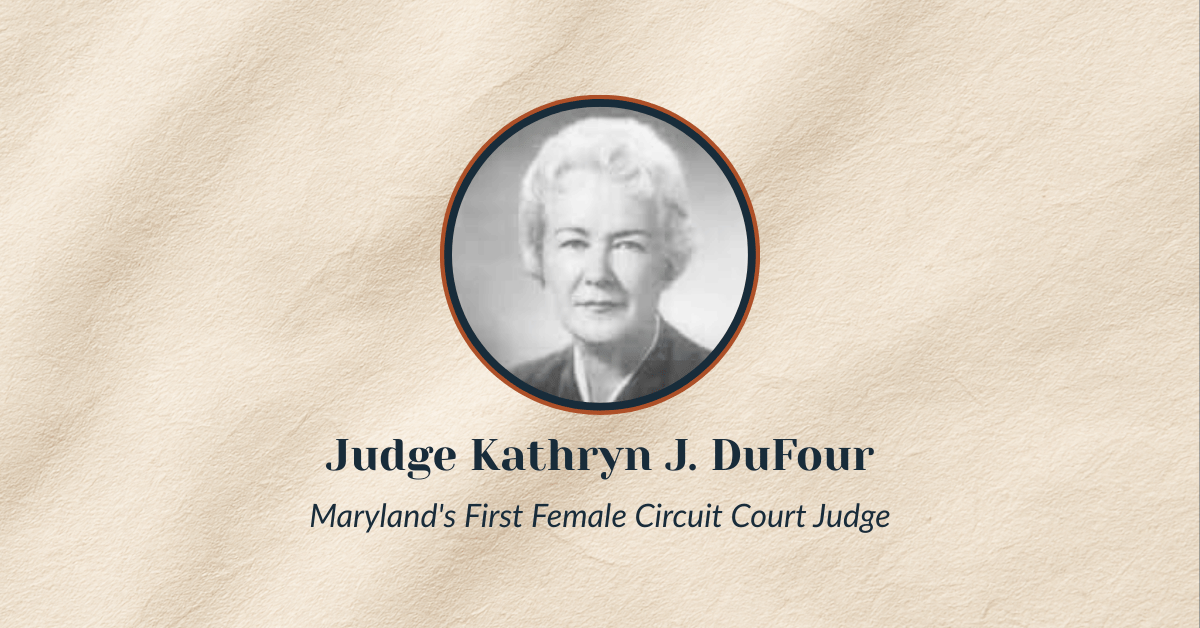
Judge Kathryn J. DuFour (March 19, 1910 — February 4, 2005) made history as the first female judge in the Maryland Circuit Courts and later its first female chief judge. Over a career spanning decades, she modernized the court system, championed the abolition of the death penalty, and blazed a trail that inspired generations of women in the legal profession. This includes Sandra Day O'Connor, the first woman Justice on the Supreme Court, who personally credited DuFour with helping pave the way.
Born in Lawrence, Massachusetts, DuFour's journey to the bench was anything but conventional. As a teenager, she pursued acting under contract with MGM and Fox Studios, playing small roles in films before her mother compelled her to leave the industry and finish high school. She went on to marry a trial attorney, raise two children, and earn her law degree. This path ultimately led her to become one of the most consequential figures in Maryland legal history.
Judge Kathryn J. DuFour’s Journey to the Courtroom
In 1928, Kathryn J. DuFour married a trial attorney. Four years later, the couple moved to Maryland. Her husband's work sparked her own interest in law, and DuFour enrolled at the Washington College of Law at American University in Washington, D.C. Notably, she was one of just three women among the 1936 graduating class.
DuFour was admitted to the bar of the District of Columbia that same year, followed by the Maryland bar in 1942 and the U.S. Supreme Court in 1948. Her career began at the Legal Aid Bureau in Washington, D.C., before she transitioned to private practice. All the while, she raised two children and found time to participate actively in her community.
Becoming Maryland's First Female Circuit Court Judge
In 1950, DuFour was elected to the Montgomery County Council. Later, she was appointed to the Maryland House of Delegates in 1953, where she served on the House Judiciary Committee. Her appointment to the Maryland Sixth Judicial Circuit Court in 1955 by Governor Theodore McKeldin marked a historic moment, making her the first female judge in the Maryland Circuit Courts.
The following year, she was elected to a full 15-year term. Known for taking initiative, DuFour hired her own secretary and paid her salary out of pocket. Moreover, she became the first judge to hire her own bailiff and private investigator. She was called upon to decide cases ranging from child support to rape and murder. Notable cases included securing an increase in support payments for a female client, a first in that jurisdiction.
Improving Maryland Case Management and Advocating for Systemic Change
When Judge Thomas M. Anderson was appointed to the Court of Special Appeals in 1967, DuFour became the first female chief judge of the Sixth Judicial Circuit Court. In that role, she pioneered the position of court administrator to improve case management. As a result, this dramatically reduced the case backlog, and she was credited with bringing the court into the twenty-first century.
In addition, DuFour successfully advocated for higher judicial salaries and courthouse expansions. Judge DuFour was further known for her opposition to the death penalty, becoming the first Maryland judge to publicly advocate against it in 1967.
Judge Kathryn J. DuFour Legacy and Recognition
Overall, Judge Kathryn J. DuFour’s impact extended far beyond the courtroom. DuFour was inducted into the Maryland Women's Hall of Fame and received the American University Alumni Association Distinguished Recognition Award. In 1982, The Catholic University of America honored her with the prestigious James Cardinal Gibbons Medal. She was also recognized as a Lady of the Equestrian Order of the Holy Sepulcher and a Dame of the Order of Malta, both offices awarded to distinguished Catholic women. In 1994, The Catholic University named its law library the Judge Kathryn J. DuFour Law Library in her honor.
Judge DuFour's influence is also captured in her own words.
"I got tired of waiting for my husband while he was trying federal cases, and went to law school myself," — Judge Kathryn J. DuFour explained to a Montgomery County newspaper in 1960
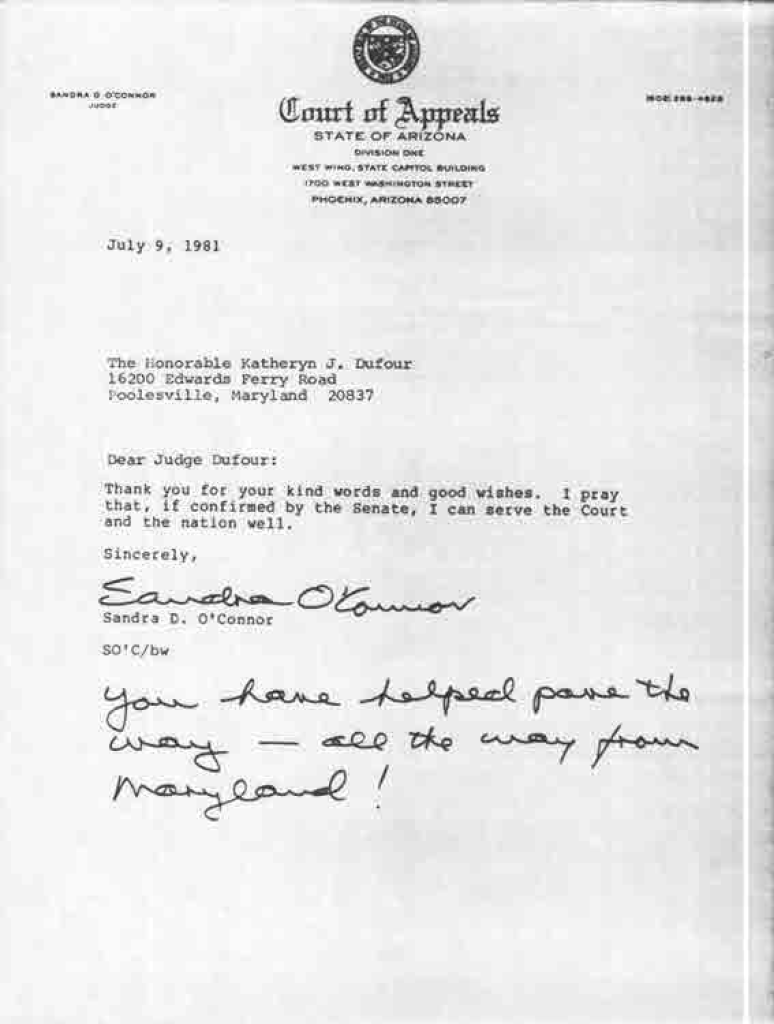
She once emphasized her identity as a judge who was a woman, not a woman who was a judge. When Sandra Day O'Connor was appointed to the U.S. Supreme Court in 1981, she sent a letter to Judge DuFour honoring her breakthrough in the judiciary. "You have helped pave the way all the way from Maryland," the letter stated.
Judge Kathryn J. DuFour retired in 1971. Her contributions lit the way forward for future generations of female judges and continue to inspire the legal community today.
The Federal Bar Association Maryland Chapter is proud of those who contribute to the Maryland legal community. To further learn about the historical figures who dedicated their lives to the rule of law, please explore our Chapter Spotlights.